

 Türkçe
Water entering the ear occurs when water accumulates in the outer ear during swimming or showering and usually causes a temporary sensation of blockage, fullness, or hearing loss. This condition is generally harmless, but water that remains for a long time may increase the risk of infection.
Tilting your head to the side and jumping lightly may help the water trapped in the ear come out. In addition, gently pulling the auricle or making movements such as yawning and swallowing increases airflow in the ear canal and facilitates the removal of water.
If pain, discharge, or hearing loss develops in the ear after water enters it, the risk of inflammation of the external ear canal (otitis externa) should be considered, and an ear, nose, and throat specialist should be consulted. When necessary, infection can be prevented with medical treatment.
| What You Need to Know | Information |
| Definition | Water entering the ear is an uncomfortable condition that usually occurs when water enters the external ear canal during swimming, showering, or bathing. It is generally temporary and may rarely lead to infection. |
| Symptoms | A sensation of blockage in the ear, mild hearing loss, the sound of water or sloshing, itching, fullness, and sometimes mild pain. |
| Common Causes | Water becoming trapped in the external ear canal after immersion, a narrow ear canal structure, or water remaining inside due to earwax. |
| Risk Conditions | If water remains in the ear for a long time, inflammation of the external ear canal (swimmer’s ear) may develop. This infection presents with itching, pain, and discharge. |
| Immediate Actions | Tilt the head to the side so that the affected ear faces downward, jump lightly, gently pull the earlobe, and make swallowing movements to help the water come out. |
| Methods That Can Be Applied at Home | Lying on the side of the affected ear may help drain the water from the ear canal through the effect of gravity. |
| What Should Not Be Done | Using cotton swabs, inserting sharp objects into the ear, blowing air with excessive force, or applying pressure inside the ear may increase the risk of infection. |
| When to Consult a Doctor | If the fullness does not resolve within 1–2 days after water enters the ear, or if pain, discharge, itching, fever, or hearing loss develops, an ear, nose, and throat (ENT) specialist should be consulted. |
| Conditions Requiring Treatment | If swimmer’s ear develops, antibiotic ear drops, painkillers, and rarely oral medications may be used. |
| Prevention Methods | Using earplugs while swimming, not tilting the head backward during bathing, paying attention to ear hygiene, and gently drying the ears after swimming are effective. |
Why Does Water Entering the Ear Cause Such an Uncomfortable Sensation?
The reason for the strange blockage and echoing sensation you feel when water enters your ear is actually entirely physical. Contrary to common belief, our external ear canal is not shaped like a straight tube. It has a slightly curved structure resembling the letter “S,” and the end of this tunnel is closed by the eardrum. In other words, it is like a “blind well” with an entrance but no exit. This anatomical structure is evolutionarily perfect for protecting the eardrum from external impacts; however, it can sometimes create a disadvantage when it comes to draining water.
Under normal conditions, healthy ear skin repels water. However, due to the physical property called surface tension, water may remain intact as a droplet in this narrow canal and may not exchange places with air. When the mass of water settles on the eardrum or an air pocket becomes trapped between the membrane and the water, the membrane’s ability to vibrate is restricted. We hear sounds because our eardrum can vibrate freely in response to waves traveling through the air. This additional water load on the membrane slows its movement. As a result, a condition called “conductive hearing loss” occurs. Sounds may seem muffled, distant, or metallic. In addition, your own voice echoes inside your head. This condition may stimulate not only hearing but also the balance center to a mild degree, causing a sensation of lightheadedness.
How Does Cerumen, the Ear’s Natural Protection Mechanism, Interact with Water?
One of the most misunderstood secretions in our body is cerumen, commonly known as “earwax.” Although most people see it as dirt that needs to be cleaned, for us professionals, cerumen is one of the ear’s most important lines of defense. This waxy secretion traps dust and particles with its sticky structure and prevents the growth of bacteria and fungi with its acidic properties. It also has water-repellent characteristics. However, when water enters the ear, this loyal protector may sometimes become the source of the problem.
If there is already some accumulated wax in your ear canal, the water entering the ear is absorbed by this wax. Just like a sponge placed in water, cerumen swells and increases in volume as it absorbs water. The small piece of wax that remains along the side of the canal and allows airflow when dry can turn into a large plug that completely blocks the canal when it swells with water. We call this a “cerumen plug.” At this point, the possibility of the water coming out on its own disappears because the path is now blocked by a physical barrier. As the water remains trapped, the wax softens further, takes on a dough-like consistency, and begins to press toward the eardrum. This causes the sensation of fullness and hearing loss to increase.
What Safe Methods Can Be Applied at Home When Water Enters the Ear?
Before panicking or inserting any object into your ear, you should try to drain the water by using the laws of physics to your advantage. Our main goal here is to break the surface tension of the water and allow gravity to do its job.
The first and most effective method is to change the position of the head. Tilt your head sideways so that the affected ear faces the ground. Sometimes simply waiting in this position may not be enough. Hold the upper part of your auricle and gently pull it backward and upward. This movement temporarily straightens the curved ear canal and creates a more direct path for the water to flow out. At the same time, lightly jumping on one foot or gently shaking the head may also help move the water.
Another safe technique is to use the vacuum effect. While your head is still tilted to the side, place your palm tightly over your ear. Press and release gently to create a pumping effect. The negative pressure created when you remove your palm may trigger the water to move outward.
What Should Never Be Done When Water Enters the Ear?
There are certain habits that our patients perform with good intentions but that dramatically worsen the situation. When your ear becomes blocked, you may instinctively feel that “I need to clean it.” However, the ear canal is not a place that can be cleaned by inserting objects. Incorrect interventions can turn a simple case of water entering the ear into a painful infection or permanent damage to the eardrum.
The objects you should absolutely avoid are listed below:
- Cotton ear cleaning swabs
- Wire hairpins or hair clips
- Toothpicks, knitting needles, etc.
- Pen caps or tips
- Keys
- Rolled paper towels or tissue tips
- Ear candles
Cotton swabs in particular are our greatest enemy in this regard. Imagine that you have a layer of wax in your ear that has swollen with water. When you insert a cotton swab, you cannot pull this soft mass out; on the contrary, you push it like a piston and compress it directly against the eardrum. The blockage becomes even more compact and becomes impossible to remove without professional intervention. In addition, these objects can very easily scratch the sensitive ear skin that has softened due to water. These microscopic scratches, which you cannot see with the naked eye, create a perfect entry point for bacteria to penetrate beneath the skin. The result is an extremely painful external ear canal infection called “Swimmer’s Ear.” Ear candles also carry a burn risk and may cause much more serious problems, such as melted wax flowing into the ear and covering the eardrum.
What Are the Symptoms Indicating That a “Swimmer’s Ear” (Otitis Externa) Infection Has Developed?
If the water has not come out of your ear and a moist, warm, airless environment has formed inside, bacterial growth is only a matter of time. When the acidic balance of the external ear canal is disrupted, bacteria commonly found in pool and seawater begin to multiply rapidly. Your body gives you clear signals indicating that a simple blockage has now turned into a medical infection (Otitis Externa).
The most prominent signs of this infection are listed below:
- Severe itching inside the ear
- Pain that increases when the auricle is touched
- Tenderness when pressure is applied to the tragus (the cartilage projection in front of the ear)
- Swelling and edema in the ear canal
- Redness at the entrance of the canal
- Clear or yellowish ear discharge
- Bad odor
- Pain radiating to the jaw while chewing
- Swelling of the lymph nodes in the neck area
- Increased hearing loss
The most distinctive among these symptoms is “Tragus Tenderness.” If it hurts when you lightly press the small cartilage projection just in front of your ear with your finger or when you move your auricle up and down, there is a 90% likelihood that this is an external ear canal infection. In middle ear infections, pain generally does not increase with these external movements. In such a case, you should stop looking for a solution at home and consult a specialist immediately because untreated external ear infections may spread and damage the cartilage tissue.
How Do We Make the Diagnosis as Specialists and Which Tests Do We Use?
When a patient comes to our clinic with the complaint “water entered my ear,” we do not perform procedures automatically. This is because what the patient perceives as “water entering the ear” may sometimes be a completely different pathology. Correct treatment begins with the correct diagnosis. For this purpose, we apply a series of specialized imaging and measurement methods in sequence.
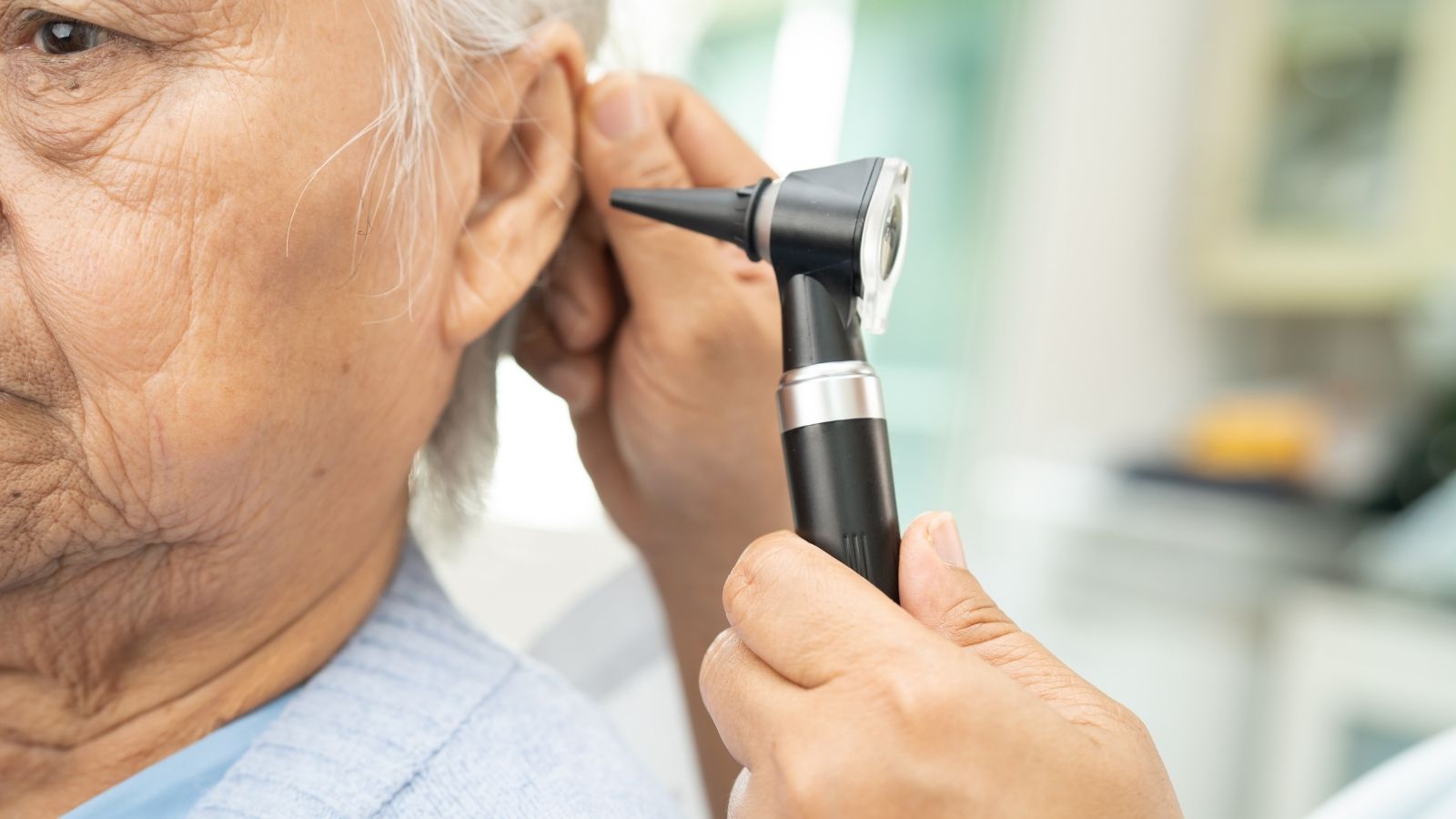
First, your ENT physician will perform an Otoscopic Examination. Using an otoscope, which is a lighted magnifying device, or a video otoscope that projects the image onto a screen, the physician will examine the deeper parts of the ear canal. This makes it possible to determine whether the cause of the blockage is truly water or hardened cerumen, whether there is redness, fungal growth, or edema on the canal skin, and most importantly, whether the eardrum is intact. Is there a perforation in the membrane? What is the color and position of the membrane? If there is a problem behind the eardrum, namely in the middle ear, the type of intervention applied externally changes completely.
The second and very critical step is the Tympanometry Test. Sometimes our patients claim that their ears are blocked and that there is water inside, but when we examine the ear with an otoscope, the canal is seen to be completely clean, and your ENT physician will refer you to audiology. The tests performed in audiology will be applied for differential diagnosis. Tympanometry measures the flexibility of the eardrum by applying slight pressure to the ear canal.
The graph types that may be obtained as a result of this test are listed below:
- Type A (Normal pressure and mobility)
- Type B (Flat line – Presence of fluid or perforation)
- Type C (Negative pressure – Eustachian tube obstruction)
If we see a flat line called “Type B” in the test result, this tells us that the problem is not in the external ear canal but in the middle ear cavity behind the eardrum. In other words, while the patient thinks that water entered the ear from the pool, they may actually be experiencing “Serous Otitis Media” (fluid accumulation in the middle ear) that developed after the flu. This distinction is vital because washing or vacuuming the ear does not help with middle ear fluid; on the contrary, medication treatment is required.
When we consider it necessary, we also perform Pure-Tone Audiometry to measure the level of hearing loss. With this test, we document how many decibels of loss the blockage has caused and confirm whether hearing returns to normal after treatment.
How Can Water Entering the Ear Be Prevented and How Can the Risks Be Reduced?
No matter how successful the treatment process is, the best option is not to experience this problem at all. Especially if you say, “My ears are very sensitive, and I experience this during every seaside holiday,” or if your ear canal is anatomically narrow, you need to make protective measures part of your lifestyle.
First of all, preventing contact with water is the most reliable method. However, standard earplugs sold in pharmacies do not fit every ear, may leak, or may cause discomfort. As an audiologist, the method I trust most is custom-made swimming earplugs. In our clinic, we take an impression of your ear canal using a putty-like material. Based on this impression, waterproof earplugs made of soft silicone that are 100% compatible with the curves of your ear are produced in a laboratory environment. These earplugs block water perfectly and can be used repeatedly.
In addition, simple precautions can also be life-saving:
- Gently drying the entrance of the ear with the edge of a towel after swimming or showering.
- Making it a habit to tilt your head to both sides and wait for the water to drain.
- Covering the ear entrance with a piece of cotton while using hair spray or dye (chemicals irritate the skin and make it more prone to infection).
- Maintaining the natural acidic balance of the ear (not applying vinegar or alcohol drops without a doctor’s recommendation).
Frequently Asked Questions

Dr. Audiologist Emel Uğur was born in 1982 in Çanakkale. She specialized in Pediatric Audiology, Otologic Disorders, and Vestibular System Disorders, and served for 15 years at the Istanbul Training and Research Hospital. In 2015, she joined the Acıbadem Healthcare Group. She currently works as an Audiologist at the Acıbadem Altunizade Hospital and also serves as a faculty member and program director in the Acıbadem University Vocational School of Health Services Audiometry Program.








Location of our clinic in Istanbul, Turkey