

 Türkçe
Modern methods in vertigo treatment consist of advanced diagnostic technologies, mechanized maneuver chairs, and vestibular rehabilitation protocols that retrain the balance centers in the brain. This modern process, which goes beyond traditional suppressive medications, begins with advanced tests such as VNG and vHIT that identify the origin of dizziness with millimetric precision. Especially in individuals with chronic balance disorders, virtual reality-supported exercises and personalized vestibular rehabilitation programs provide lasting recovery by enabling the nervous system to compensate for error signals. These advanced applications, managed from an audiological perspective, are the most effective scientific solutions that improve the patient’s quality of life and restore functional independence.
How Does the Balance System in Our Body Work and What Is Vertigo Really?
The human body’s ability to know where it is in space, walk without falling, and continue daily life depends on an extraordinary information processing process that takes place deep within the brain. Our body constantly collects data from the environment to maintain this perfect balance. These data come from three main centers. The first is the balance organ in our inner ear, the second is our eyes, and the third is the special receptors in our muscles and joints. Whenever you move, walk, or even simply sit in a chair, these three systems continuously send real-time position reports to the brain. The brain analyzes these incoming reports within fractions of a second. Thanks to this flawless analysis, we maintain an upright posture and keep our visual field stable while looking around.
Vertigo occurs when one of these perfectly functioning systems becomes disrupted. Vertigo is not actually a disease by itself but rather the manifestation of another underlying problem. When a problem develops in the balance center of the inner ear or in the nerve pathways leading from this center to the brain, conflicting messages begin to reach the brain. While your eyes and muscles report that you are standing still, your damaged inner ear sends false information to your brain indicating that you are spinning rapidly. When the brain cannot resolve this conflict, the person feels as if the surrounding objects are spinning rapidly, the ground is slipping beneath their feet, or they are being tossed through empty space. Modern clinical approaches focus on finding the source of this conflict and correcting it.
How Does the Vestibular System in Our Inner Ear Maintain Balance?
Contrary to what many people believe, our inner ear is not merely an organ that enables us to hear sounds; it is also an extremely complex and delicate biomechanical structure responsible for maintaining our balance. Within this structure are specialized components that detect every movement of our head. There are semicircular canals that detect movements when you turn your head from side to side or nod it up and down. Meanwhile, otolithic organs detect linear movements when you accelerate in a car, descend in an elevator, or stand against gravity. These organs contain special fluids and microscopic crystals. The moment you move, these fluids shift, the crystals change position, and these changes are transmitted directly to the brain through the vestibular nerve.
This remarkable communication network has two critical functions that are essential for maintaining our daily lives. The first is the reflex that allows your eyes to remain fixed on the object you are looking at while you are moving. If you do not see your surroundings as blurry while walking or lightly jogging and can read signs around you, it is thanks to the commands your inner ear sends to your eye muscles within fractions of a second. The second important function is to keep our body upright against gravity. When there is a problem in the inner ear, these remarkable reflexes weaken or begin functioning asymmetrically. As a result, involuntary eye movements and severe balance loss occur.
How Does Our Brain Resolve the Problem of Vertigo on Its Own?
The human brain has an extraordinary ability to repair damaged systems or assume their functions through alternative pathways. This flexibility, scientifically known as neuroplasticity, is also the key to the permanent recovery from vertigo. When one side of the inner ear is damaged, the brain initially experiences a major shock. It cannot determine how to respond, and severe dizziness attacks occur. However, over time, our brain initiates a repair process by reorganizing information from the healthy ear, visual input from the eyes, and sensory feedback from the muscles.
The main mechanisms supporting this recovery process are:
- Adaptation
- Habituation
- Substitution
The adaptation process means that the brain gradually becomes accustomed to the faulty signals coming from the inner ear and readjusts eye movements according to this new condition. Habituation is the process in which the brain gradually extinguishes its excessive response to dizziness-inducing movements by performing those movements in a controlled manner. Substitution is an even more fascinating mechanism; over time, the eyes and muscles take over the function that the damaged inner ear system can no longer perform, compensating for that deficiency through alternative pathways.
What Are the Advanced Technological Methods Used in the Diagnosis of Vertigo?
Correctly identifying the source of dizziness is the first and most critical step toward successful recovery. Starting treatment blindly by relying solely on the patient’s complaints not only wastes valuable time but also further reduces the individual’s quality of life. Today, advanced technological devices are used to determine with millimetric precision whether dizziness originates from a specific part of the inner ear, a particular nerve, or a region of the brain.
The modern methods most frequently used in evaluations are:
- VNG
- vHIT
- VEMP
- CDP
Thanks to these technologies, it can be determined definitively whether the problem originates entirely from the inner ear or involves the brain, cerebellum, or neural pathways. Selecting the correct diagnostic method completely changes the direction of treatment.
How Does the Videonystagmography (VNG) Test Detect Dizziness?
Considered one of the most reliable methods in the world for diagnosing dizziness, the VNG test records eye movements using special goggles equipped with high-resolution infrared cameras. One may wonder why the eyes are examined to understand a problem in the inner ear. The inner ear and the eyes are closely connected. The inner ear sends direct commands to the eye muscles. Therefore, the best way to understand the condition of the inner ear is by examining the subtle involuntary eye movements.
During the VNG test, the individual wears these special goggles in a dark environment. They are asked to follow moving lights displayed on a screen. Meanwhile, the cameras record the speed, pauses, and movements of the pupils. The most important stage of the test involves delivering warm or cool air into the ears. This temperature change causes the fluid inside the inner ear to move, producing a very mild and temporary sensation of dizziness. This is a completely expected and desired response. In this way, the symmetry between the right and left inner ears and the presence of weakness or reduced function on one side can be measured mathematically.
What Does the Video Head Impulse Test (vHIT) Measure and Why Is It Important for Vertigo?
The vHIT is another advanced technology test that has revolutionized the diagnosis of dizziness. It is extremely fast, reliable, and not tiring for the individual. Unlike traditional methods, this technology has the ability to evaluate each of the six semicircular canals in the inner ear individually and independently. This feature provides tremendous convenience for targeted treatment.
The test procedure is very simple, but the results it provides are remarkably comprehensive. The individual looks at a fixed point on the wall in front of them. The specialist then rapidly turns the person’s head through very small angles to the right, left, upward, or downward. High-tech goggles simultaneously record the movements of the pupils. In a healthy inner ear, no matter how quickly the head turns, the eyes never leave the fixed target. However, if there is damage in the inner ear, the eyes move along with the head and lose fixation on the target. Immediately afterward, the eyes make a corrective movement within a fraction of a second to regain the target. The system detects this delay and identifies which canal is affected.
What Problems Deep Within the Inner Ear Does the VEMP Test Reveal?
The VEMP test, known as Vestibular Evoked Myogenic Potentials, is used to evaluate the deeper regions of the inner ear responsible for detecting gravity and linear movements. This electrophysiological method measures the reflex responses of the neck and eye muscles to specific sound stimuli delivered to the ear.
The inner ear structures evaluated by the VEMP test are:
- Utricle
- Saccule
These structures are located at the very center of the inner ear. The VEMP test is an invaluable tool for evaluating the effects of fluid pressure in Meniere’s disease, commonly known as inner ear hydrops, or for determining whether there is structural thinning in the inner ear bone (SSDC). It is a completely painless examination in which the individual simply listens to sounds and gently contracts the neck muscles while providing highly valuable diagnostic information.
How Is Balance Loss Analyzed with Computerized Dynamic Posturography (CDP)?
CDP is a highly advanced platform technology that objectively measures an individual’s balance strategies, which sensory systems they rely on, and their risk of falling. The person stands on a special platform equipped with movable, highly sensitive pressure sensors. Surrounding them is a movable visual enclosure or display. This system creates various misleading scenarios to determine which sensory system responsible for balance is impaired.
For example, when the platform beneath the individual’s feet tilts slightly according to foot movements, the person’s ability to rely solely on the inner ear is evaluated. If the individual cannot ignore misleading sensory information and instead focus on the accurately functioning sensory inputs, maintaining balance on the platform becomes difficult. The device collects these data to calculate how quickly the individual sends signals to the muscles and how they adjust their center of gravity. This test clearly identifies which sensory system should become the primary focus of the rehabilitation program.
How Does the Maneuver Chair (TRV Chair) Offer an Innovation in BPPV Treatment?
The most common type of dizziness in society is the condition popularly known as “displacement of the inner ear crystals.” This condition is called BPPV. In traditional treatment, specialists attempt to reposition the displaced crystals by turning the person’s head and body at specific angles on an examination table. However, performing these maneuvers on a treatment table can be extremely difficult for individuals with cervical disc herniation, obesity, spinal osteoarthritis, or physical mobility limitations.
This is precisely where the technological innovation known as the maneuver chair comes into play. This chair is a mechanized system capable of rotating the individual through a full 360 degrees in three-dimensional space. The person is secured safely in the chair using seat belts. Because the neck and spine remain completely stabilized, no physical strain or pain occurs. Thanks to the special camera-equipped goggles integrated into the chair, the movement of the crystals within the canal can be monitored very clearly on the screen. Moreover, in highly resistant cases where the crystals become lodged within the canal, the chair’s specialized vibration feature helps release them, significantly increasing the treatment success rate.
How Does Virtual Reality (VR) Technology Contribute to Vertigo Treatment?
Virtual reality has introduced an enjoyable, safe, and highly effective dimension to the treatment of dizziness. Some individuals with vertigo experience severe dizziness, nausea, and lightheadedness, particularly while walking through crowded supermarket aisles, looking at patterned carpets, or watching moving vehicles in heavy traffic. This condition is known as visual vertigo and can turn the person’s social life into a nightmare.
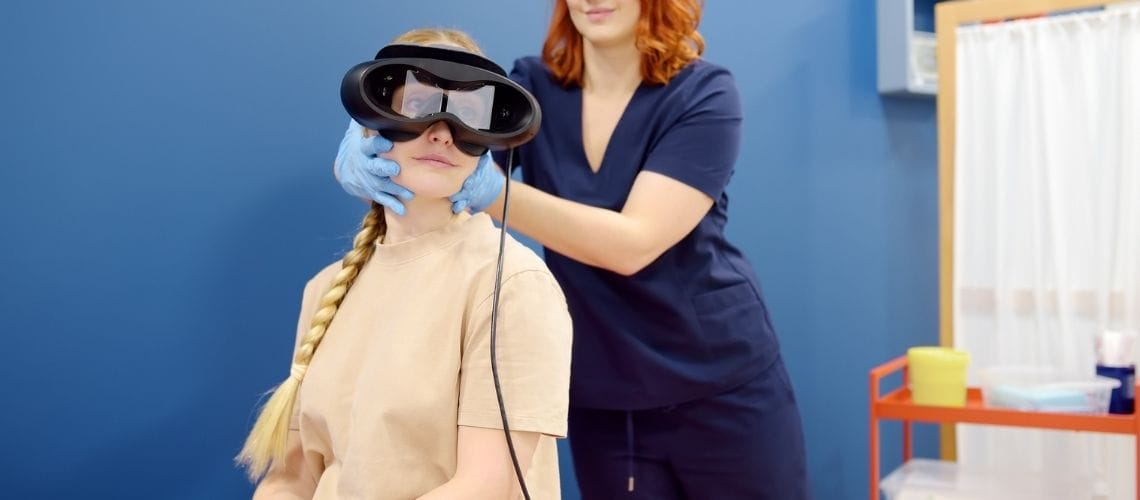
VR treatment is performed by fitting the individual with a personalized virtual reality headset. While remaining completely safe within the clinical environment, the individual is gradually exposed to the same virtual environments that cause discomfort in everyday life. The goal is to gradually desensitize the brain to complex and visually dynamic environments. The system starts with the mildest dizziness-triggering visual scenarios and progressively increases the level of difficulty. Thanks to gamified scenarios, the process becomes engaging rather than monotonous, while the brain’s formation of new neural pathways progresses much more rapidly.
What Stages Does the Vestibular Rehabilitation Process Consist Of?
Vestibular rehabilitation is a completely personalized exercise prescription designed to accelerate the brain’s recovery process in chronic balance disorders that do not improve with medication, following inner ear diseases, or after surgical procedures. Since every individual’s dizziness profile, lifestyle, and degree of damage differ, a unique rehabilitation program is prepared according to the results of detailed diagnostic testing.
Some of the fundamental exercise groups included in the rehabilitation program are:
- Eye tracking exercises
- Head and neck movements
- Unstable surface training
- Walking and coordination exercises….
This treatment process generally lasts between four and eight weeks, depending on the individual’s condition. The sessions performed under specialist supervision in the clinic are extremely valuable, but the true key to success is consistently performing the exercises learned in the clinic at home exactly as instructed by the specialists. Performing the exercises regularly is the most important factor enabling the brain to recognize the error signals and establish a new sense of balance.
How Is PPPD, Which Causes a Persistent Feeling of Dizziness, Managed?
Another balance disorder that has been much more clearly defined in recent years and significantly affects many people’s lives is the condition known as PPPD. These individuals generally do not experience severe spinning attacks in which the surroundings rotate violently. Instead, they experience a continuous feeling of dizziness lasting for months, often describing it as “it feels like there is a weight in my head,” “I constantly feel as if I am walking on clouds,” or “it feels like I am inside a boat and rocking.” They often visit numerous hospitals, yet no abnormalities are found in laboratory tests.
PPPD is generally rooted in the psychological and neurological effects left behind by a genuine episode of dizziness experienced in the past. Even if the inner ear has recovered, the brain cannot forget the initial disturbance and remains in a constant state of heightened alertness and hypersensitivity. This condition is further reinforced by anxiety and stress, creating a vicious cycle. In managing this condition, conventional balance exercises alone are insufficient. A comprehensive rehabilitation program is implemented, including virtual reality training to reduce visual sensitivity, relaxation exercises, and strategies aimed at reducing the brain’s excessive protective response. Through this approach, the persistent feeling of dizziness gradually disappears.
How Should Medication Be Used During the Vertigo Treatment Process?
During the initial days when dizziness is most severe, using certain medications to suppress nausea, vomiting, and the intense spinning sensation is entirely natural and necessary. However, once the acute crisis has passed and the individual enters the vestibular rehabilitation phase, which is responsible for the actual recovery process, medication use becomes an issue that must be managed very carefully.
The goal of rehabilitation is for the brain to perceive the weak and faulty signals coming from the inner ear, confront them, and develop new pathways to correct them. If the individual continues using suppressive medications with sedative effects for a prolonged period, the brain will never recognize that an error exists. When the error is not recognized, the repair process cannot begin, and recovery may be delayed for months or even years. Therefore, once the exercise program begins, these types of medications are generally discontinued gradually under supervision or reduced to the minimum possible level.
What Precautions Should People Experiencing Dizziness Take to Prevent Falls?
One of the most dangerous and feared consequences of dizziness is sudden falls caused by balance loss, especially in older adults, which may result in serious bone fractures. In addition to medical treatment and rehabilitation exercises, making the home and physical environment safer is an essential part of the recovery process.
Simple yet life-saving precautions that should be taken at home include:
- Motion-sensor night lights
- Non-slip bathroom mats
- Wall-mounted grab bars
- Secured or removed carpet edges
- Rubber-soled indoor shoes
In addition, dizziness is often triggered by sudden changes in position, such as getting out of bed abruptly or standing up quickly after bending over. Therefore, instead of jumping out of bed immediately upon waking, it is advisable to sit on the edge of the bed for one minute, allowing blood pressure and inner ear fluids to stabilize. This is the first rule for starting the day safely. If the rehabilitation process has not yet been completed, individuals should never hesitate to use a cane or walker temporarily outdoors if recommended by specialists.
What Are the Primary Responsibilities of Audiologists in the Management of Vertigo and Balance Disorders?
Within the complex world of hearing and balance systems, audiologists play a key role at every stage, from diagnosing dizziness to achieving a lasting solution. Vertigo is not like a common cold that completely resolves the next day with a single pill; it is a condition that must be understood, accurately evaluated using specialized technology, and patiently reconstructed.
Audiologists work closely as part of a multidisciplinary team with Ear, Nose and Throat physicians and Neurologists. They personally perform all of the advanced technological tests used to unravel the mysteries of the inner ear. By analyzing eye movement recordings, neck muscle reflexes, and movements on balance platforms, they map exactly where the problem originates. In cases such as displaced inner ear crystals, they safely reposition the crystals using either a maneuver chair or manual techniques. Most importantly, for chronic balance disorders, they design personalized exercise programs, utilize technologies such as virtual reality, and guide the individual step by step throughout the weeks-long recovery journey.

Dr. Audiologist Emel Uğur was born in 1982 in Çanakkale. She specialized in Pediatric Audiology, Otologic Disorders, and Vestibular System Disorders, and served for 15 years at the Istanbul Training and Research Hospital. In 2015, she joined the Acıbadem Healthcare Group. She currently works as an Audiologist at the Acıbadem Altunizade Hospital and also serves as a faculty member and program director in the Acıbadem University Vocational School of Health Services Audiometry Program.










Location of our clinic in Istanbul, Turkey