

 Türkçe
Free-field audiometry is a technique used to determine hearing levels in infants and children according to their age and level of cooperation. It is also used to evaluate the effectiveness of hearing aids in individuals who use them. Hearing responses are measured by presenting sounds from different directions through loudspeakers. It can be performed in both children and adults.
This test is particularly preferred in young children when headphone-based measurements are difficult to perform. Since the sound stimuli simulate a natural listening environment, the results closely reflect real-life hearing conditions.
Free-field audiometry is used to verify the accuracy of hearing aid settings. It is also utilized to evaluate device performance in cochlear implant users.
The test results are interpreted by an audiologist to optimize the individual’s device settings. This helps improve communication quality and supports auditory development.
What Exactly Is Free-Field Audiometry?
Free-field audiometry is a hearing test in which sounds are presented through loudspeakers in an open space, and the individual’s ability to perceive these sounds is evaluated. This method refers to hearing assessments performed through speakers placed within the room rather than using headphones.
To explain this with an everyday example, imagine a music system. Instead of wearing headphones while listening to music, you hear it through a speaker in the room. Even though factors such as echoes, distance, and room acoustics are present, you can still hear the music. Free-field audiometry is a more controlled, scientific, and medical version of this concept. Since the acoustics of the testing room are specially designed, echoes and background noise are minimized, while the intensity, frequency, and type of sound presented through the loudspeaker are carefully controlled. This makes it possible to determine the individual’s hearing threshold, or the lowest sound intensity they can detect.
This test is particularly useful for young children who refuse to wear headphones or are not accustomed to using hearing devices. Presenting sounds through loudspeakers allows infants and young children who are not yet able to cooperate to turn toward the sound source or be rewarded with toys, making the testing process easier. Of course, it is not only useful for children; it is also preferred for hearing aid users who have difficulty wearing headphones or when the clinician wants to evaluate how much benefit they are receiving from their hearing aids. Free-field audiometry can be used to evaluate aided or unaided hearing levels across all age groups.
How Is Free-Field Audiometry Performed?
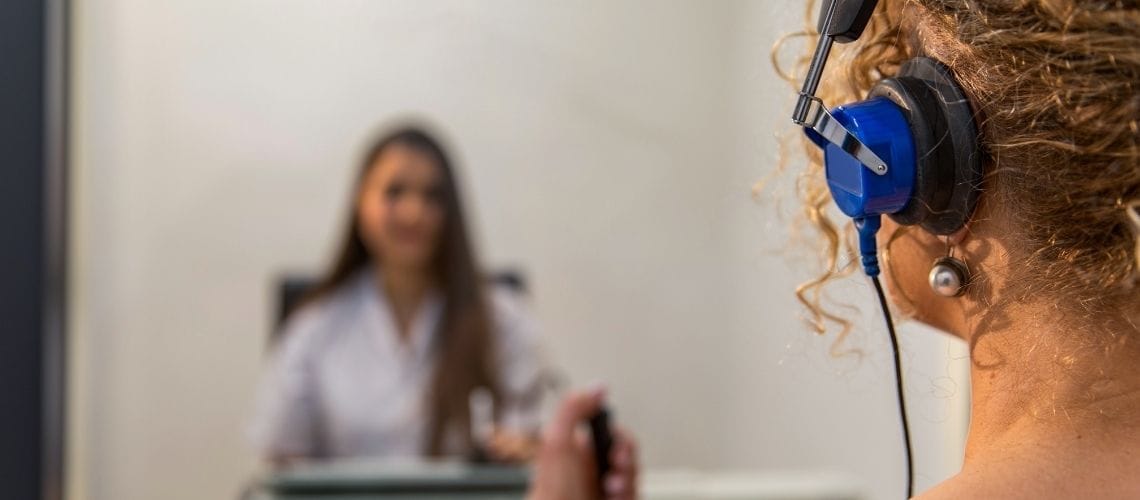
Free-field audiometry is performed in a sound-treated room with controlled acoustics. The individual usually sits on a chair or remains on a parent’s lap while sounds are presented through pre-calibrated loudspeakers positioned within the room.
Before testing begins, the patient is made comfortable. You can think of the environment as resembling a playroom, except that it has been acoustically insulated to minimize external noise. The loudspeakers are generally positioned approximately one meter away at ear level. Depending on the test protocol, the direction from which the sounds are presented may vary. Some tests use a single speaker positioned in front, while others use speakers placed on both the left and right sides.
When the sounds begin, an adult participant indicates when a sound is heard—for example, by raising a hand, pressing a button, or responding verbally. Children may respond by turning toward the sound or completing a previously learned play task. In very young infants, careful observation and visual reinforcement techniques are commonly used. The infant is expected to turn toward the sound, and a colorful toy or animated visual is presented in that direction as positive reinforcement.
Sounds of different frequencies (such as 500 Hz, 1000 Hz, and 2000 Hz) and different intensity levels (measured in decibels) are presented throughout the test. The goal is to determine the lowest sound intensity at which the individual responds. The results are then plotted on an audiogram, providing information about the individual’s hearing thresholds.
What Types of Sounds Are Used in Free-Field Audiometry?
The primary objective of free-field audiometry is to determine whether a person can perceive sounds under conditions that resemble real-life listening environments. Instead of using fixed-frequency pure tones, this test typically employs frequency-modulated “warble tones” or narrow-band noise.
Why are warble tones or narrow-band noise used instead of pure tones? In a room environment, a fixed-frequency sound wave may create standing waves, resulting in areas where the sound is perceived as louder or softer than intended. Warble tones continuously fluctuate around a central frequency, helping minimize this effect and providing more stable and reliable measurements.
Speech sounds may also be used during testing. Particularly in children, stimuli may range from simple words such as “mama” and “dada” to the well-known “Ling-6” speech sounds. Speech testing provides much more meaningful information about an individual’s ability to understand spoken language in everyday situations. Therefore, speech perception testing is especially valuable when evaluating the performance of hearing aids or cochlear implants.
In Which Situations Is Free-Field Audiometry Preferred?
- One of the primary applications of free-field audiometry is in infants and young children. In particular, it is preferred for children who resist wearing headphones, have difficulty cooperating, or have ears that are too small for standard headphones.
- Because infants often have limited cooperation, using games and colorful sounds presented through speakers makes testing much easier. Likewise, this method is highly beneficial for individuals with special needs. For children who have difficulty wearing headphones or who have tactile sensitivity, such as those with autism spectrum disorder, creating a game around responding to sounds from a loudspeaker encourages participation and can make the testing process more enjoyable while promoting shared attention.
- Free-field audiometry is also an excellent option for adults who wear hearing aids. Since testing is performed while the hearing aid is being worn under conditions similar to everyday life, it provides a more realistic assessment of the device’s actual performance than headphone testing.
- A similar approach is used for cochlear implant users. Their level of adaptation to the implant, responses to soft sounds, and speech perception abilities can be evaluated more effectively through free-field measurements.
What Are the Advantages of Free-Field Audiometry?
Free-field audiometry offers several important advantages. Since it closely reflects natural listening conditions, it provides highly valuable information.
The advantages include:
- No Need for Headphones
Some individuals have ear anatomy that makes headphone use difficult, while infants often remove them repeatedly. Since testing is performed using loudspeakers, these issues are largely eliminated. Play-based and visually reinforced techniques also make testing much easier for young children while reducing stress.
- Listening Conditions Similar to Real Life
In everyday life, whether talking to someone or hearing traffic sounds, both ears work together. Likewise, free-field testing presents sounds to both ears simultaneously, providing a more realistic picture of everyday hearing ability.
- Easier Evaluation of Hearing Devices
When hearing aids or cochlear implants are being worn, using headphones may not be technically practical. Instead, sounds are presented directly through loudspeakers, allowing clinicians to determine the lowest sound intensity the individual can hear. This provides a clear indication of the benefit provided by the hearing device.
- A More Comfortable Transition
Children may become frightened by headphones or refuse to wear them. Conducting the test in a free-field environment using toys and colorful visual reinforcements makes it easier for them to cooperate. Likewise, adults who experience discomfort or anxiety with headphones may also benefit from this approach.
What Are the Limitations of Free-Field Audiometry?
Although free-field audiometry offers many advantages, it also has several limitations. This test does not provide ear-specific diagnostic information, meaning it cannot independently determine the hearing level of each ear.
When sounds are presented through loudspeakers, both ears hear the same stimulus. Even if only one ear has normal hearing, the individual will still detect the sound using that ear. Therefore, headphone-based audiometry or masking techniques are still required to determine whether the right or left ear hears better. In addition, free-field audiometry alone cannot determine the type of hearing loss, whether conductive, sensorineural, or mixed. Additional tests such as bone conduction testing and tympanometry are necessary.
Another limitation involves room acoustics. Sound may reflect from walls, ceilings, and other surfaces, creating echoes. Therefore, proper sound insulation and accurate loudspeaker placement are essential. Otherwise, the measured hearing thresholds may not accurately represent the individual’s true hearing ability.
Similarly, even small head movements can alter the sound level reaching the ears. For this reason, individuals are asked to keep their heads as still as possible during testing, and if significant movement occurs, portions of the test may need to be repeated.
How Are Free-Field Audiometry Results Interpreted?
The results of free-field audiometry represent the hearing level of the individual’s better-hearing ear. For example, if responses are obtained at intensities as low as 20 dB across certain frequencies, it generally indicates that at least one ear has hearing within or close to the normal range.
However, this test does not provide separate results for each ear. If elevated thresholds are observed, meaning responses occur only at higher sound intensities, it suggests that even the better-hearing ear requires louder sounds for detection. This indicates the possibility of hearing loss, although additional headphone-based audiometric testing or advanced assessments are required to determine its exact type and severity.
In children, free-field testing is often supplemented by objective assessments such as ABR or followed by conventional headphone testing once the child reaches an appropriate age and level of cooperation. Free-field audiometry frequently serves as an initial assessment. If a child shows no response or only responds at very high sound levels, early intervention for hearing loss becomes important. Nevertheless, these findings alone are not sufficient to conclude that the child has no hearing. Comprehensive evaluation is always necessary.
For hearing aid and cochlear implant users, free-field audiometry results are also reported as “aided thresholds.” In other words, the clinician evaluates the lowest sound level the individual can detect while wearing the device. This information helps determine whether the hearing aid or implant settings are appropriate, how effectively speech sounds are being perceived, and whether programming adjustments are needed.
What Is the Difference Between Free-Field Audiometry and Headphone Audiometry?
Compared with headphone-based (or insert earphone) audiometry, free-field audiometry provides a more natural listening environment. The main difference is straightforward: in free-field testing, sounds are presented through loudspeakers and heard by both ears simultaneously, whereas headphone audiometry measures each ear separately, allowing for a much more detailed diagnosis.
During headphone testing, the audiologist can present sounds to one ear while masking the opposite ear with noise, making it possible to measure the hearing level of each ear individually. This allows accurate determination of which ear hears better, as well as the type and severity of hearing loss. In free-field testing, since sounds are heard by both ears together, it is not possible to determine independently whether the right or left ear performed better.
Additionally, headphone audiometry delivers pure tones directly into the ear canal, minimizing the influence of room acoustics. External noise is also largely eliminated, resulting in greater diagnostic precision and frequency-specific accuracy. In contrast, free-field audiometry requires specially designed testing rooms to minimize the effects of sound reflections from walls, ceilings, and other surfaces. Even under ideal conditions, however, a small amount of environmental influence may still remain.
Frequently Asked Questions

Dr. Audiologist Emel Uğur was born in 1982 in Çanakkale. She specialized in Pediatric Audiology, Otologic Disorders, and Vestibular System Disorders, and served for 15 years at the Istanbul Training and Research Hospital. In 2015, she joined the Acıbadem Healthcare Group. She currently works as an Audiologist at the Acıbadem Altunizade Hospital and also serves as a faculty member and program director in the Acıbadem University Vocational School of Health Services Audiometry Program.




Location of our clinic in Istanbul, Turkey